



Sold out
MATEKSYS ExpressLRS 2.4GHz Receiver - ELRS R24 D
MATEKSYS ExpressLRS 2.4GHz Receiver - ELRS R24 D
Regular price
Rs. 1,961.35
Sale price
Rs. 1,961.35
Regular price
Tax included.
Shipping calculated at checkout.
Out of stock
Share this product
SKU: 4674
-
The MATEKSYS ELRS R24 D Receiver is a 2.4GHz ExpressLRS diversity receiver with 22.5dbm Telemetry Power and two IPEX MHF 1 antennas.
VIDEO: Mateksys Express LRS receivers ELRS-R24-S and ELRS-R24-D under a microscope
Features
- 22.5dbm Telemetry Power
- IPEX MHF1 Antennas
- 2.4GHz Frequency
- ExpressLRS
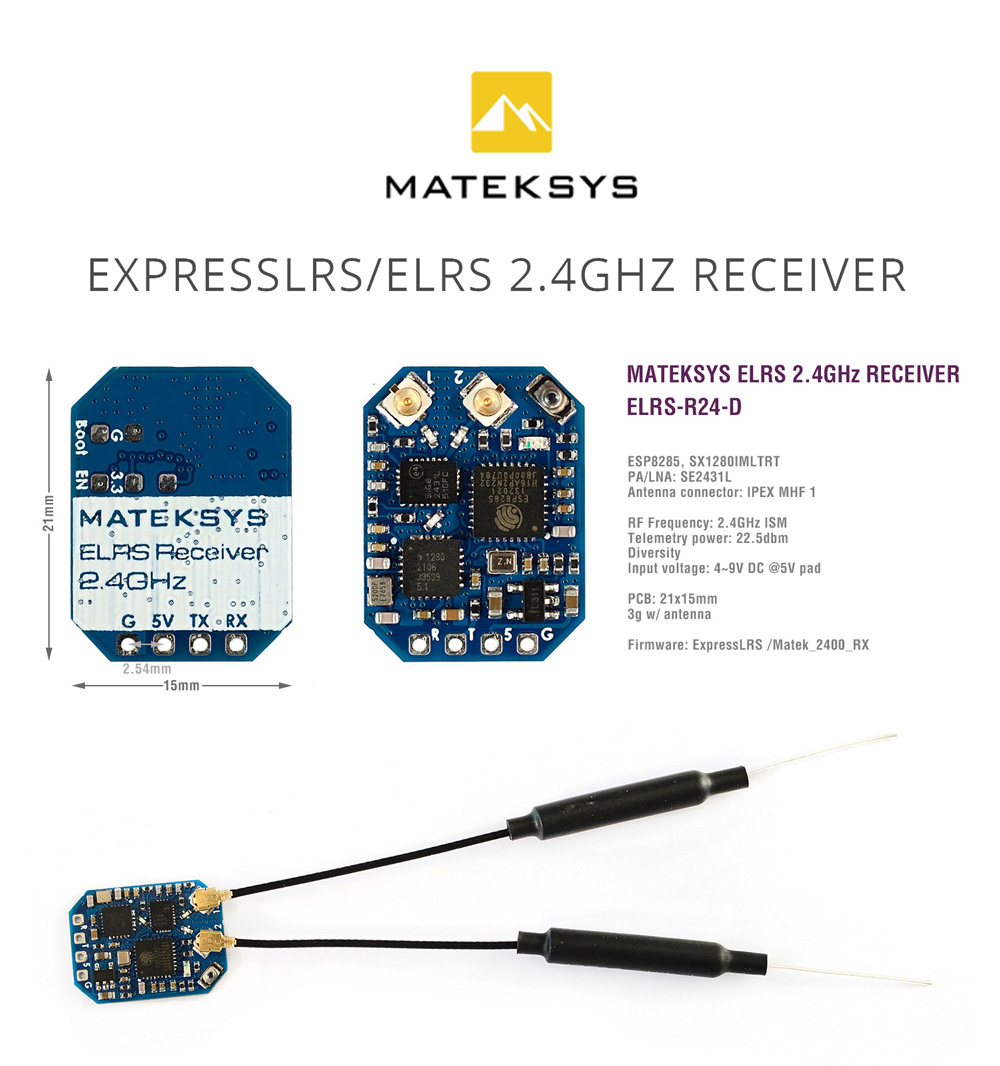
Specifications
- Power dissipation: 40~45mA(before binding), 70~75mA(binding), 90~95mA(wifi mode)
- Diversity (antenna-switching), default ANT2
- RF Frequency: 2.4GHz (2400~2480MHz)
- Telemetry power: 22.5dbm~23dbm
- Input voltage: 4~9V DC @ 5V pad
- Antenna connector: IPEX MHF 1
- ESP8285, SX1280/1281IMLTRT
- SE2431L RX_gain: 12.5dB
- Weight: 3g (With Antennas)
- PCB size: 21mm x 15mm
- Receiver protocol: CRSF
- PA/LNA: SE2431L
FIRMWARE TIPS
- ELRS-R24-D: Enable “USE_DIVERSITY” (checked) when flashing in ExpressLRS configurator
- Firmware: ExpressLRS MATEK_2400_RX
- Firmware update via UART or WIFI
Downloads
- ELRS_V2.0.0_NoPhrase_ELRS-R24-D.bin
- ELRS_V1.2.0_NoPhrase_ELRS-R24-D.bin
- ESP_NodeMCU-PyFlasher.exe
- 3D Step File
Includes
- 1x MATEKSYS ExpressLRS 2.4GHz Receiver - ELRS R24 D
- 2x IPEX MHF1 Antennas
Question 1.
How does the True Diversity Receiver technology work, and what benefits does it offer?
Understanding True Diversity Receiver Technology
The True Diversity Receiver technology utilizes two antennas paired with dual receiver chains and integrates advanced TCXO (temperature compensated crystal oscillator) technology. This design ensures that signals are accurately received without losing frequency precision, even in challenging environments.
How Does It Work?
-
Dual Antennas and Receiver Chains: The technology employs two antennas, each linked to a separate receiver chain. This setup allows the receiver to constantly switch to the strongest signal, drastically reducing the likelihood of signal loss or interruption.
-
Temperature Compensated Crystal Oscillator (TCXO): TCXO provides a stable clock source, shared by the dual RF chips. This feature guarantees that frequency remains steady and precise, regardless of fluctuations in temperature.
-
True Diversity: By incorporating two RF chips and amplifiers (PA+LNA), the receiver can sustain a stable connection by processing data from both antennas simultaneously.
-
Heat Management: The design effectively manages the heat generated during operation, ensuring that the receiver maintains high performance without overheating. This becomes crucial during prolonged use or in extreme temperature conditions.
Benefits of True Diversity Receiver Technology
-
Super Accurate Frequency Stability: The inclusion of TCXO ensures that frequencies remain exceptionally stable and accurate. This is vital for maintaining consistent performance in various temperatures.
-
Enhanced Signal Reliability: The dual antenna setup improves signal reliability significantly. This means fewer interruptions and a more robust connection, crucial for long-range applications.
-
Temperature Resilience: With the ability to withstand extreme heat and cold without compromising functionality, the technology enables devices to perform effectively in diverse environments.
-
Extended Operation: By efficiently handling heat, these receivers can operate continuously over longer durations, enhancing their use in demanding scenarios.
In summary, True Diversity Receiver technology offers superlative frequency accuracy, reliable signals, and resilience against extreme temperatures, providing a substantial advantage in various applications.
Question 2.
What is ExpressLRS, and how can individuals participate in its open-source project?
What is ExpressLRS?
ExpressLRS is an open-source radio control (RC) link designed for various RC applications. It aims to provide reliable and efficient communication for hobbyists and professionals alike. Open-source by nature, it allows developers and enthusiasts to contribute, innovate, and enhance its capabilities collectively.
Participate in the Open-Source Project
If you're interested in joining this dynamic community, there are a few ways to get involved:
-
Explore the Code on GitHub: The project's entire codebase is available on GitHub, where you can browse the repository, fork it, and even contribute code improvements or new features.
-
Engage with the Community: Join discussions, ask questions, and share ideas with other ExpressLRS users on platforms like Facebook. This is a great way to stay updated on the latest developments and collaborate with others who share your passion.
-
Contribute Your Ideas: Whether you're a developer, tester, or simply an enthusiast, sharing your insights and feedback can help shape the future of ExpressLRS. Your input is valuable and welcomed by the community.
By engaging with ExpressLRS, you become part of a vibrant ecosystem that thrives on cooperation and shared expertise.
Question 3.
How can the firmware of the SuperD ELRS 2.4G Diversity Receiver be flashed using Passthrough or WIFI?
How to Flash Firmware on the SuperD ELRS 2.4G Diversity Receiver
Flashing the firmware on your SuperD ELRS 2.4G Diversity Receiver is a straightforward process that can be done via either Passthrough mode or WIFI. Follow these steps to ensure a smooth update:
Option 1: Passthrough Mode
-
Update ExpressLRS Configurator: Ensure your ExpressLRS Configurator is updated to version 1.5.2 or a later version. This will guarantee compatibility with the latest firmware.
-
Connect Your Receiver: Link your SuperD receiver to a compatible flight controller capable of Passthrough flashing.
-
Select the Device:
-
Open ExpressLRS Configurator.
-
Locate and select the target device labeled “SuperD 2.4GHz RX”.
-
-
Flash the Firmware:
-
Click on the "Build and Flash" button.
-
Your flight controller will communicate with the receiver to complete the firmware update.
-
Option 2: WIFI Method
-
Enable WiFi Mode on Receiver:
-
Power up your SuperD receiver and enable WiFi mode. This often requires pressing the boot button until the indicator LED flashes in WiFi mode.
-
-
Connect to Receiver’s WiFi Network:
-
On your computer or smartphone, scan for available WiFi networks.
-
Connect to the network that corresponds with your receiver.
-
-
Access the Update Interface:
-
Open a web browser and enter the default IP address (often something like 10.0.0.1) to access the firmware update interface.
-
-
Upload and Install Firmware:
-
Use the interface to upload the firmware file.
-
Follow the on-screen instructions to complete the installation.
-
By following these steps, you can ensure that your SuperD ELRS 2.4G Diversity Receiver is running the latest firmware, keeping your equipment up-to-date and functioning optimally.
Question 4.
What items are included in the package of the SuperD ELRS 2.4G Diversity Receiver?
When you purchase the SuperD ELRS 2.4G Diversity Receiver package, you'll find everything you need to get started. The package includes:
-
SuperD ELRS 2.4G Diversity Receiver: Ensures reliable and long-range connectivity.
-
Two T-Shaped Dipole Antennas: Designed for optimal signal reception.
-
Pin Header: Essential for easy installation and connectivity.
-
Set of Silicon Wires: Includes four wires—black, red, white, and yellow—for versatile wiring options.
-
User Manual: Provides detailed instructions for setup and operation.
This comprehensive package equips you with the necessary components for an effective and seamless installation process.
Question 5.
How is the SuperD ELRS 2.4G Diversity Receiver configured and bound with a flight controller using Betaflight firmware?
Configuring and Binding the SuperD ELRS 2.4G Diversity Receiver with a Flight Controller
Configuring and binding your SuperD ELRS 2.4G Diversity Receiver with a flight controller that's running Betaflight firmware involves a few key steps. Here's a comprehensive guide to get your setup operational:
Setting Up the Flight Controller
-
Connect the Hardware:
-
Establish a connection between the SuperD diversity receiver and your flight controller. This is typically done through the UART ports on the flight controller.
-
-
Configure Betaflight:
-
Open the Betaflight Configurator and go to the "Ports" tab.
-
Enable the serial port your receiver is connected to (for example, UART1). Set this port as “Serial Rx.”
-
-
Receiver Settings:
-
Navigate to the "Configuration" page in Betaflight.
-
Set the Receiver Mode to "Serial (via UART)."
-
Choose “CRSF” (Crossfire Serial Protocol) for the Serial Receiver Provider option.
-
Binding the SuperD Receiver
-
Prepare for Binding:
-
Ensure your SuperD receiver’s firmware version is at least ExpressLRS V3.0.0, as both the receiver and transmitter need to match this version or be newer.
-
-
Enter Binding Mode:
-
Power the SuperD diversity receiver on and off three times, allowing a 1-second interval between each power cycle. This sequence puts the receiver into Binding Mode.
-
-
Indicator Check:
-
When the receiver enters Binding Mode, its RGB indicator will flash twice rapidly.
-
-
Complete Binding:
-
Use your remote control or transmitter to initiate binding with the receiver. A solidly lit RGB indicator on the receiver signifies a successful bind.
-
Final Notes
-
Once bound, the receiver memorizes the binding setup and automatically re-establishes connection upon subsequent power cycles, eliminating the need to repeat the binding process.
-
It's crucial to maintain the 1-second interval during the power cycling process to ensure proper binding mode activation.
This setup process ensures that your SuperD ELRS 2.4G Diversity Receiver is seamlessly integrated with your flight controller, offering reliable communication and control.
Question 6.
What types of FPV aircraft can the SuperD ELRS 2.4G Diversity Receiver be used with, and what performance benefits does it provide?
Versatile Applications of the SuperD ELRS 2.4G Diversity Receiver
The SuperD ELRS 2.4G Diversity Receiver offers remarkable versatility as it is compatible with a wide array of FPV aircraft. Whether you're flying drones or fixed-wing models, this receiver is designed to enhance your flight experience. Its adaptability makes it suitable not just for standard FPV drones but also for other types of FPV aircraft, including single-rotor helicopters and multi-rotor platforms.
Performance Benefits
-
Long-Range Capability: The SuperD receiver excels in extending the reach of your remote-controlled flights, ensuring consistent and reliable connections over greater distances.
-
Enhanced Stability: With its cutting-edge technology, you can expect smoother and more stable control, reducing the likelihood of signal dropouts or interference.
-
Broad Compatibility: The receiver's compatibility with various aircraft types makes it an ideal choice for hobbyists who operate multiple FPV platforms.
These features combine to offer an enhanced FPV flying experience, allowing pilots to enjoy the thrill of responsive, long-range flights across different types of aircraft.
Question 7.
What are the related products to the SuperD ELRS 2.4G Diversity Receiver, and what are their prices?
Related Products to the SuperD ELRS 2.4G Diversity Receiver
If you're exploring options complementary to the SuperD ELRS 2.4G Diversity Receiver, here's a curated list of related products along with their prices:
-
High-Power VTX with Pigtail: Delivering an initial 25mW, this robust VTX is designed for performance enhancements.
Price: ₹2,899 -
Powerful VTX for Ultimate Coverage: Offering a 2W output, this VTX provides extensive range and stability for your flying needs.
Price: ₹3,699 -
Switchable vTX with Pigtail: This option offers 5.8GHz 40CH switching capabilities, ideal for versatile flying experiences.
Price: ₹1,799 -
VTX for Advanced Setup: Tailored for users seeking ultimate performance in various conditions.
Price: ₹2,199 -
VTX with DVR Functionality: Capture your flights effortlessly with this integrated DVR VTX setup.
Price: ₹2,299 -
High-Capacity AIO Board: The GN 405S is a powerful option for those in need of an all-in-one board solution.
Price: ₹7,999 -
Advanced Flight Controller Stack: Designed for high-performance applications, this stack includes a 55A capability.
Price: ₹7,999 -
Compact Flight Controller Stack: Packing a punch with a 45A rating, this mini stack meets demanding flight needs.
Price: ₹7,499
Explore these options to enhance your setup and optimize your flight experiences. Each product offers unique features catering to different levels of performance and budget.
Question 8.
How does the TCXO technology enhance the performance of the SuperD ELRS 2.4G Diversity Receiver in extreme temperatures?
How TCXO Technology Boosts the Performance of the SuperD ELRS 2.4G Diversity Receiver in Extreme Conditions
The SuperD ELRS 2.4G Diversity Receiver is equipped with cutting-edge TCXO, or temperature compensated crystal oscillator, technology. So, how does this technology enhance its performance, especially in extreme temperatures?
-
Precision in Temperature Fluctuations:
The TCXO provides an exceptionally stable and precise clock source. By compensating for temperature variations, it ensures that the receiver maintains accuracy regardless of hot or cold weather conditions. This prevents frequency drifts, which are common issues in traditional oscillators exposed to temperature swings.
-
Reliable Long-Range Performance:
TCXO aids in sustaining accurate frequency output essential for reliable long-range flight. By keeping the signals stable, it ensures consistent connectivity even when the receiver generates substantial heat during operation, or is subjected to chilly environments.
-
Enhanced Heat Management:
The receiver's design includes two RF chips and PA+LNA, which naturally produce high heat. TCXO's stable frequency output means it can withstand these high temperatures without performance degradation. This resilience ensures that the receiver functions optimally without fear of overheating, thus safeguarding long-range communication.
In summary, TCXO technology enhances the SuperD ELRS 2.4G Diversity Receiver’s performance by ensuring precision under varying temperatures, providing reliable signal stability, and managing the heat generated during intensive use.
Question 9.
What are the LED status indications on the SuperD ELRS 2.4G Diversity Receiver, and what do they signify?
LED Status Indications on the SuperD ELRS 2.4G Diversity Receiver
The SuperD ELRS 2.4G Diversity Receiver utilizes a series of LED color codes and flashing patterns to communicate various operational statuses. Here's a breakdown of what each LED indication signifies:
-
Rainbow (Fade Effect): This vibrant display indicates that the receiver is powered on and functioning normally.
-
Green (Quick Flash): Signals that the receiver is currently in WiFi upgrading mode. This is typically used during firmware updates.
-
Red (Quick Flash): Alerts that no RF chip is detected, which means the receiver can't initiate the connection process.
-
Orange (Double Flash): Indicates that the receiver is in binding mode, ready to connect with a transmitter.
-
Orange (Triple Flash): Happens when the receiver is connected, but there's a mismatched model-match configuration. This highlights the need for a configuration adjustment.
-
Orange (Slow Flash): Signifies that the receiver is awaiting a connection. This mode is common before the initial binding or reconnection attempts.
-
Solid Color: When the LED remains solidly lit, it indicates a stable connection. The specific color represents the packet rate, though additional context on the colors and their meanings is typically provided in accompanying documentation or figures.
These LED patterns and colors are essential for quickly diagnosing the receiver's status and ensuring seamless operation.
Question 10.
What is the BetaFPV TXCO SuperD ELRS 2.4G Diversity Receiver, and what are its key features?
What is the BetaFPV TXCO SuperD ELRS 2.4G Diversity Receiver?
The BetaFPV TXCO SuperD ELRS 2.4G Diversity Receiver is a cutting-edge device designed to enhance the performance and reliability of radio-controlled models, such as drones and aircraft. As a pioneer in its field, this receiver integrates advanced technology to ensure consistent and precise signal reception, even in challenging environments.
Key Features:
-
Dual Antenna System: This receiver boasts a true diversity setup, employing two antennas along with dual receiver chains. This technology ensures a robust link by selecting the best signal available, thus enhancing reliability.
-
Temperature Compensation: Equipped with a Temperature Compensated Crystal Oscillator (TCXO), the receiver maintains accurate frequency rates across varying temperatures, making it ideal for extreme conditions.
-
Compact and Lightweight: Weighing in at just 1.1 grams without its antenna, this receiver features a streamlined design that is easy to work with, especially during soldering.
-
Omnidirectional Signal Transmission: By utilizing two Dipole T antennas, the receiver provides a comprehensive signal transmission. For optimal performance, it is recommended to position the antennas vertically and as far apart as possible.
-
Versatile Applications: Beyond drones, this receiver is suitable for a wide range of radio-controlled vehicles, including FPV fixed-wing aircraft, ensuring exceptional long-range flying capabilities.
-
Latest Firmware: The device comes pre-installed with the ExpressLRS V3.0.0 firmware, based on the latest official specifications, to deliver up-to-date performance and features.
This receiver stands out with its innovative features, catering to enthusiasts who demand reliability and extended range in aerial photography, freestyle flying, and more.
Question 11.
What are the specific technical specifications of the BetaFPV TXCO SuperD ELRS 2.4G Diversity Receiver?
Technical Specifications of the BetaFPV TXCO SuperD ELRS 2.4G Diversity Receiver
When delving into the specifics of the BetaFPV TXCO SuperD ELRS 2.4G Diversity Receiver, here's a clear breakdown of its key technical features:
-
Microcontroller Unit (MCU): The device employs an ESP32 PICO D4, integrated with dual SX1280 (SX1281) chips, for efficient processing and communication.
-
Antenna Connection: It is equipped with an IPEX MHF 1/U.FL connector, ensuring secure and reliable antenna attachment.
-
Radio Frequency (RF): Operating within the standard 2.4GHz band, it covers a frequency range of 2400 to 2480MHz, which is suitable for a variety of use cases.
-
Telemetry Output: The receiver offers a telemetry power output of 20dBm, equivalent to 100mW, providing robust signal strength.
-
Communication Protocol: It utilizes the CRSF (Crossfire) protocol, renowned for its low latency and long-range capabilities.
-
Power Requirements: The device requires a +5V DC input, precisely delivered via the “+” pad on the board.
-
Physical Dimensions: Measuring at 22mm by 14mm, the compact PCB design ensures easy integration into various setups.
-
Weight Considerations: The weight of the receiver is 1.1 grams, not including the antenna, making it a lightweight component for your project needs.
This comprehensive overview of the BetaFPV TXCO SuperD ELRS 2.4G Diversity Receiver outlines its functional and design features, ensuring that you are well-informed to make an educated decision.
Question 12.
What are the differences between the SuperD RX, Micro RX, Nano RX, and Lite RX in terms of weight, antenna type, MCU, and RF chip?
Comparing the RX Models: A Breakdown
When considering different RX models, it's essential to understand how they differ in key areas such as weight, antenna type, MCU, and RF chip. Here's a detailed look at the distinctions among the SuperD RX, Micro RX, Nano RX, and Lite RX:
Weight
-
SuperD RX: The heaviest among the group, it weighs in at 1.1 grams, focusing on offering robust performance features.
-
Micro RX: This model weighs 3.5 grams, providing a balance between size and functionality.
-
Nano RX: Significantly lighter, it comes in at just 0.7 grams, catering to setups where compactness is crucial.
-
Lite RX: The lightest option available, it offers two configurations—0.47 grams for the tower version and 0.53 grams for the flat version.
Antenna Type
-
SuperD RX, Micro RX, Nano RX: These models utilize the IPEX MHF connector paired with a T antenna, ensuring reliable connectivity.
-
Lite RX: It stands out with its SMD ceramic antenna, offering a more integrated and compact antenna solution.
MCU (Microcontroller Unit)
-
SuperD RX: Equipped with the ESP32-PICO-D4, it features dual SX1280 modules, enhancing its processing power and efficiency.
-
Micro RX, Nano RX, Lite RX: All three models are built with the ESP8285 microcontroller, presenting a consistent platform for varied applications.
RF Chip
-
SuperD RX: Utilizes dual SX1280 chips, complemented by dual PA, delivering a powerful and robust signal.
-
Micro RX: Features the SX128X RF chip, focusing on consistent and reliable radio frequency performance.
-
Nano RX: Combines the SX1280 with an additional PA and integrates an SX1276 with PA for enhanced performance adaptability.
-
Lite RX: Shares the SX128X chip with the Micro RX, ensuring competitive signal capabilities in a lightweight package.
This comparison highlights the unique features of each model, allowing you to choose the one that best fits your specific needs based on weight, connectivity, processing power, and radio frequency capabilities.
The RCM Difference
Shipping Pan India
100% genuine products
Rigorous checks before shipping

